A=1 Discrete Causal Lattice
  • Home
  • News
  • Roadmap
  • Papers
    • All papers
    • Claim map
    • Paper I — Geometry First
    • Paper II — Geometry Forces Physics
  • Research artifacts
  • Essays
  • Collaborators
  • Funding
  • About
  • Bio
  • Contact

On this page

  • Where to start
  • Latest news
  • Edit this page
  • Report an issue

A=1 Discrete Causal Lattice

Geometry first. Geometry forces physics. Geometry axiomatizes physics.

Substrate-first physics — emergent Lorentz invariance, the origin of the Standard Model gauge group, and gravity as clock-density — all from a single conservation law on a discrete-spacetime causal lattice.
NoteStatement of Intent

The A=1 discrete causal lattice is not proposed as the literal microscopic structure of the universe. Instead, it is a mathematically defined geometric object whose intrinsic constraints induce conservation laws, symmetries, and interaction patterns reminiscent of known physics.

My research program investigates the expressive power of this object: what physical structures it can encode, what symmetries it supports, and how far its induced geometry can be pushed toward reproducing the Standard Model and general relativity.

This is an exploration of mathematical capability, not an ontological claim.

NoteOn falsifiability

A framework worth taking seriously must be able to be wrong — so this program treats falsifiability as something to earn and search for, not to assume. The claims that could currently kill the framework, calibrated against existing physics, are collected in the claim map’s standing falsifiable predictions — the one place the program commits to falsifiable claims. Predicting genuinely new physics, rather than recovering known physics, is a further ambition gated on the forthcoming mathematics papers and the A=1 nuclear-chemistry work — and is not claimed until it arrives. Elsewhere, the program asserts mathematical capability, not measured confirmation.
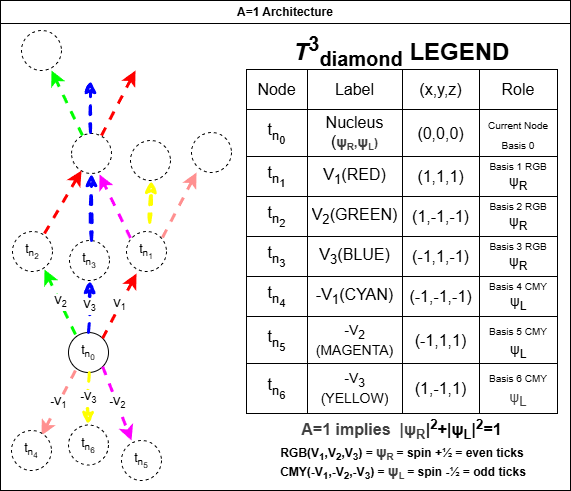
Diagram of the A=1 architecture: a central nucleus node t_n0 with six labeled neighbours t_n1..t_n6 in RGB (red, green, blue) and CMY (cyan, magenta, yellow), reached by basis vectors V1, V2, V3 (and their negatives). A legend table on the right gives the (x,y,z) coordinates and spin role for each basis.

Bipartite octahedral lattice — the A=1 substrate. RGB and CMY basis directions V_1, V_2, V_3 encode even / odd ticks; A=1 implies |\psi_R|^2 + |\psi_L|^2 = 1 (from Paper~I).

The A=1 Discrete Causal Lattice (DCL) program takes a single conservation law on a discrete-spacetime bipartite octahedral lattice and uses it to recover emergent Lorentz invariance, locate the origin of the Standard Model gauge group, recast gravity as a clock-density effect, and predict a quantum analogue of the Roche limit. Successive papers in the series advance a single methodological arc:

  1. Geometry first (Paper I) — the substrate is a discrete causal lattice, and the rest follows.
  2. Geometry forces physics (Paper II) — the Standard Model gauge group is recovered from a single conservation axiom, with containment established and exact equality left open.
  3. Geometry axiomatizes physics (capstone, in progress) — the methodological arc is closed into a Hilbert-Sixth-shaped axiomatization.

This site is the public surface for the series. It tracks news, hosts research artifacts that don’t fit a paper-figure shape (3D models, animations, interactive visualizations), and gives an entry-point for readers, collaborators, and endorsers.

Where to start

  • Papers — the canonical series, with Zenodo DOIs, arXiv links, and repository links.
  • Research artifacts — 3D models, visualizations, interactive demos.
  • News — releases, deposits, talks, milestones.
  • Essays — short-form methodological writing.

Latest news

New essay: The same-but-different motif

When you cannot see a generator directly, how do you gain confidence you have guessed the right one? A new essay on the “same but different” motif as a subjective, prior-shifting cue for the modeler — with a guard against apophenia, and three illustrations held to it.

Jun 22, 2026

New essay: Expressive power, not ontology

Is the A=1 lattice “real”? That’s the wrong question. A new essay on why the realism question isn’t well-posed, why that doesn’t make the lattice unfalsifiable theology, and why conceding “not the truth” costs the program nothing while “no better than any alternative” would cost everything.

Jun 12, 2026

New: a public roadmap for the A=1 program

A single page tracking the operational status of every subproject, paper, and research investigation in the A=1 Discrete Causal Lattice series — grouped In Progress / Todo / Done, generated from the public project board.

Jun 10, 2026

dcl-core v0.2.1: exact integer A=1, and the hunt for a probability floor

dcl-core v0.2.1 (the v0.2.0 release plus a patch) is deposited on Zenodo and tagged on GitHub. Its integer-token engine lets us test discrete A=1 against continuous probability — and ask whether there is a minimum Δp, a floor.

Jun 9, 2026

New essay: answering the retrodiction charge

A new essay takes the retrodiction objection head-on — and answers the strong form, not the easy one: the freeze refutes post-hoc tuning, minimality bounds design-time selection, and only the novel predictions clear the rest.

Jun 9, 2026
No matching items

See all news →

© Jack D. Menendez. Site code: MIT; prose: CC BY 4.0.

Source on GitHub

  • Edit this page
  • Report an issue

Built with Quarto.